Sherpatrappa to Fløya: 1,200 stone steps above Tromsø
The Nepalese-built staircase climbs 421 meters from Tromsdalen to the Storsteinen plateau, with Fløya (671m) another 45 minutes above. The most-walked mountain path in the Arctic.
Sherpatrappa is a 1,200-step stone staircase built by Nepalese sherpas between 2015 and 2019. It climbs from the Fjellheisen cable car base in Tromsdalen to the Storsteinen viewpoint at 421m, with an onward ridge to Fløya at 671m. Free, year-round (with winter caveats), and the single fastest way to put Tromsø below your boots.
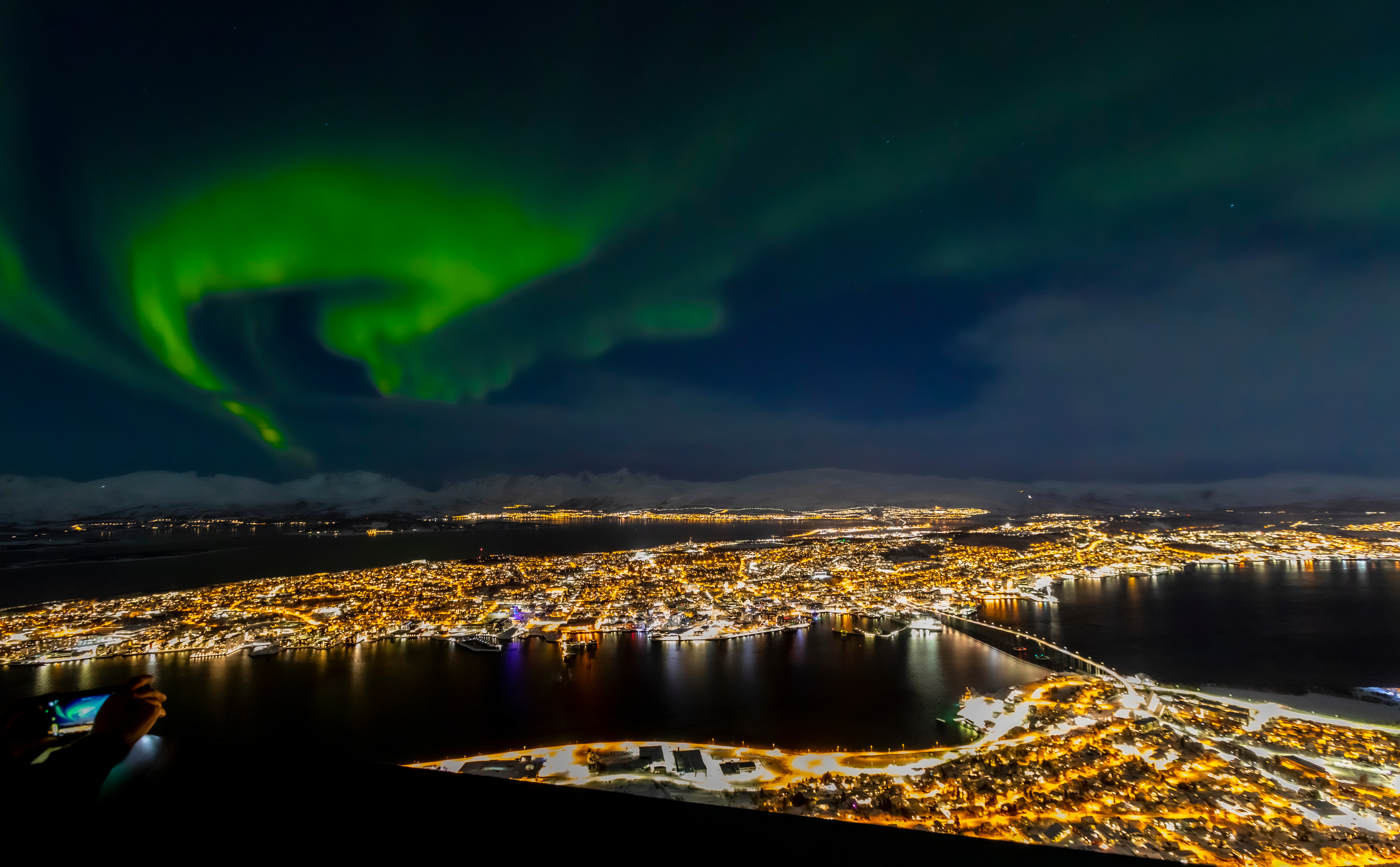
Every visitor to Tromsø looks up at the same mountain. Fløyfjellet sits directly across Tromsøysundet from the city centre, with the Fjellheisen cable car line running up its western face. Until 2015, the only way onto that mountain on foot was a rough path through birch forest and scree. Then the Nepalese sherpas arrived.
Sherpatrappa (the Sherpa Stairs) opened in sections between 2015 and 2019. Fifteen Nepalese stone-workers, most of them trained on the Himalayan trekking paths of their home country, cut and set roughly 1,200 granite steps up the steepest face of the mountain. The project was commissioned by Ishavskysten Friluftsråd (the regional outdoor council) and funded by Troms county, Tromsø municipality, and the Norwegian Environment Directorate. The total cost ran to approximately 14 million NOK across four construction seasons.
What they built is the most-walked mountain path in Nord-Norge. On a clear Saturday in July, counters have registered over 2,000 ascents in a single day. The stairs have a known failure mode for underprepared visitors: a step count that looks manageable on paper and an elevation profile that separates the fit from the optimistic within the first 200 steps.
What this trail actually is
The path is a staircase. Not a metaphorical one. Granite blocks, cut on site and set into the hillside, forming a continuous stepped route from approximately 20m at Solliveien in Tromsdalen to 421m at the Fjellheisen upper station (Storsteinen). The elevation gain is 400 meters over roughly 2 kilometers of stair length.
From Storsteinen, a well-worn footpath continues north along the ridge to Fløya, the actual summit of Fløyfjellet at 671m. This section is not sherpa-built. It is an earth-and-rock trail across alpine tundra with exposed sections above 500m. The total ascent from Tromsdalen to Fløya is 650m over about 3 km.
Most people stop at Storsteinen, take the panoramic photograph over Tromsø, and ride the Fjellheisen cable car back down. Some continue to Fløya. Very few do both ways on foot.
Three routes up the mountain
Option 1: Sherpa Stairs up, cable car down. 1.5 to 2.5 hours of climbing, 8 to 10 minutes of descent. Buy a one-way Fjellheisen ticket (NOK 185 adult) at the upper station. Cars run every half-hour, extended to evening in aurora season. The easiest knee-friendly plan.
Option 2: Full round trip on foot. 3 to 4 hours, 800m of cumulative elevation change. The descent on the granite steps is harder than the ascent. Trekking poles help. Not recommended for anyone with prior knee or ankle problems.
Option 3: Stairs to Storsteinen, continue to Fløya. Add 45 minutes each way from Storsteinen to the Fløya summit ridge. 4 to 5 hours total. The summit view opens north toward Lyngen Alps and east over Ullsfjord. The upper ridge is exposed to wind and weather changes fast.
What works
- The build quality. The Sherpa stonework is solid. Most steps are cut from single blocks of local granite, set with drainage channels that prevent ice buildup for most of the shoulder season. The Miljødirektoratet assessment in 2023 rated the structural condition as good with minor maintenance needs concentrated in the upper third.
- The access. The trailhead is a 10-minute drive or a 20-minute bus ride (route 26) from Tromsø city centre. Parking at the Fjellheisen base costs 50 NOK for 4 hours. The path is 50 meters from the cable car ticket office. No wilderness approach.
- The year-round potential. Summer access is straightforward. Winter is a different calculation. When snow covers the steps (typically late October to April), the route becomes an ice-climb requiring crampons or microspikes plus poles. Locals do walk the stairs in winter, but the Fjellheisen operator posts daily condition warnings, and rescue callouts for underprepared visitors spike between November and February.
- The view threshold. Storsteinen sits at exactly the altitude where Tromsø lays itself out clearly below: the island, the mainland, the Arctic Cathedral, Tromsøysundet bridge. Fløya is taller but further back. For most visitors, the Storsteinen viewpoint is the photograph they came for.
What does not work
- The first 300 steps. The gradient is steeper on the lower section than the upper, and many visitors underestimate it. The stone spacing is regular but tall. Legs burn within 10 minutes. Turning back is a valid decision. Nobody posts a photograph of the parking lot.
- Winter conditions on the unimproved upper ridge. Fløya sits above the treeline and above the sherpa-built section. Between November and May the ridge can hold hard ice, blown-in snow, and whiteout conditions that appear without warning. Two rescue operations per year on this section is typical. If the cloud base is below 600m, Fløya is off the menu.
- The cable car crowds. Fjellheisen moves up to 4,500 people per day in July. Storsteinen viewpoint is a queue between 11:00 and 15:00. The stairs are an escape from this. Time your ascent to arrive before 10:00 or after 17:00 and the summit is yours.
- The descent on wet stone. Rain makes the granite slippery, particularly on the polished upper sections. The handrail runs only intermittently. Wet descents are the most common injury mechanism. If the forecast is rain, go up on the stairs and down on the cable car.
The honest assessment
Sherpatrappa is not a wilderness hike. It is a piece of outdoor infrastructure carrying over 150,000 ascents per year into alpine terrain that did not previously support that volume. The value is the access: 400m of elevation in 90 minutes, a panoramic Arctic city view from a functional mountain summit, and no guide required.
For first-time Tromsø visitors with two half-days, this is the trail. For anyone who wants to say they walked up a Norwegian mountain in an afternoon, this is the trail. For hikers looking for solitude in alpine terrain, it is not the trail.
The extension to Fløya takes this from a tourist staircase into a genuine summit day. Most visitors do not make that extension. The ones who do return with a different photograph than the one everyone shares from Storsteinen.
The logistics
| Detail | Information |
|---|---|
| Trailhead | Solliveien 12, Tromsdalen (Fjellheisen lower station) |
| Distance (stairs to Storsteinen) | ~2 km one way, approx. 1,200 steps |
| Elevation to Storsteinen | 400 m (from 20 m to 421 m) |
| Continuation to Fløya summit | +1 km, +250 m (total 671 m) |
| Time up (stairs only) | 1.5–2.5 hrs depending on fitness |
| DNT grade | Blue (medium). Fløya extension: Red (strenuous) above the treeline |
| Trail fee | Free |
| Fjellheisen one-way | NOK 185 adult, NOK 95 child (4–15) |
| Fjellheisen return | NOK 295 adult, NOK 150 child |
| Parking (lower station) | NOK 50 for 4 hours |
| Bus from centre | Route 26, 20 minutes from Sentrum |
| Season | Year-round. Winter (Nov–Apr): microspikes essential |
| Trailhead GPS | 69.6490°N, 18.9920°E |
| Emergency | 112 (police/rescue) or 113 (medical) |
Trail safety
The Fjellvettreglene (Mountain Code) has nine rules. Four of them apply directly to Sherpatrappa:
- Rule 2: Adapt the trip to ability and conditions. The stairs are DNT Blue. The Fløya extension is Red. The two halves are not the same hike. Do not commit to the ridge if conditions have changed by the time you reach Storsteinen.
- Rule 3: Pay attention to weather. The summit of Fløya sits above the treeline and is the first thing weather hits when a front crosses from the Norwegian Sea. yr.no gives a reliable 6-hour forecast. Check it at the upper station before committing to the ridge.
- Rule 4: Be equipped to help yourself. Shell layer, hat, gloves, water, headlamp if you are walking in shoulder season when daylight ends fast. Mobile coverage is continuous on the stairs and intermittent on the ridge.
- Rule 8: Turn back in time. Storsteinen is a valid destination. If the ridge is in cloud or the wind is above 15 m/s, take the cable car down and come back another day.
Who should walk this
- Fit visitors with a half-day. The stairs fit into an afternoon slot between tours. Up on foot, down on the cable car, back in the city by dinner.
- Photographers waiting for aurora. Storsteinen is a working aurora viewpoint on clear winter nights. The cable car runs to 23:00 in season. The walk up at 19:00 in February, when the last light hits the ridge, is worth the cold.
- Runners. Local trail runners use the stairs for vertical training. Fastest-known-time up is under 22 minutes. This is not a goal for most visitors, but knowing it exists helps calibrate the average 90-minute ascent.
Who should skip this
- Anyone with knee or ankle problems. Long steep stairs are harder on joints than equivalent trail hiking. If you cannot manage 1,200 uneven steps without pain, ride the cable car and save your knees for flat terrain.
- Winter visitors without microspikes. Between November and April the stairs can hold packed ice for weeks at a time. Regular hiking boots are insufficient. Microspikes are available to rent in Tromsø from NOK 150 per day at outdoor shops like Verdens Beste Butikk.
- Visitors on a tight tour schedule. Budget 3 hours minimum for the round trip including cable car. If your cruise ship gives you 4 hours in port, pick the cable car return instead of the stairs.
Bjørn Haugen is the Arctic Field Editor at NorgeTravel. He has guided in Nord-Norge and Svalbard for over twenty years and volunteered with Arctic search and rescue. He writes about the Arctic so underprepared travellers do not become statistics. He can be reached at hei@norgetravel.com.
Source data: Ishavskysten Friluftsråd project reports (2015–2019); Miljødirektoratet trail assessment 2023; Fjellheisen operator data 2024; Troms and Finnmark county visitor statistics.