Lofoten Islands
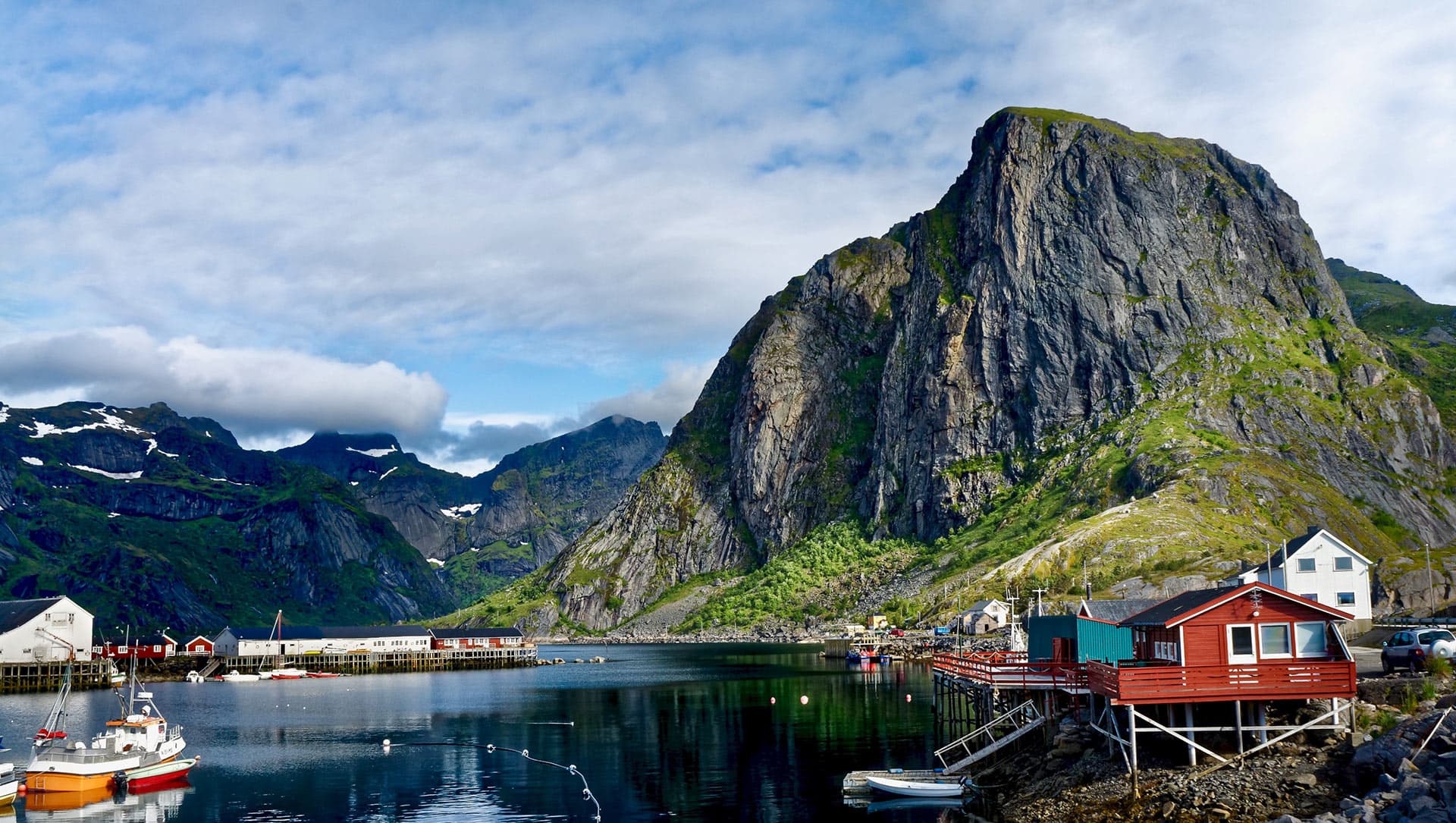
Mountains rise 1,000 metres straight out of the Norwegian Sea. Red rorbu sit on stilts over the water. The most photographed archipelago in Europe, with over a million visitors a year against 25,000 residents.
Latitude
68°N
Residents
25,000
Annual visitors
1+ million
Area
1,227 km²
Airports
SVJ / LKN
Currency
NOK
About Lofoten
Lofoten is a chain of six main islands reaching 150 km into the Norwegian Sea from the Nordland coast. Jagged granite peaks drop directly into deep fjords. The E10 road connects Austvågøya to Moskenesøya across a sequence of bridges. No ferry is required between the islands themselves. The archipelago sits at 68°N, north of the Arctic Circle, under the auroral oval.
The cod fishery has shaped Lofoten for a thousand years. Arctic cod (skrei) migrate from the Barents Sea every January to spawn here, and have done since the Viking Age. 20,000 tonnes of fish are dried on wooden racks (hjell) every winter. The racks fill the coastline through February and the smell is part of visiting in spring. In 1893 a storm killed 130 fishermen in a single night. The Stockfish Museum in Å tells the story in 90 minutes.
Tourism changed the islands in the 2010s. Over a million visitors now arrive annually. A 40:1 ratio against the resident population. Reinebringen had to be reinforced with a 1,978-step sherpa-built staircase in 2019 to stop the trail eroding. Henningsvær stadion, the football pitch on the rocks, was photographed to global attention in 2017 and the village has not been quiet since. The working harbours continue regardless. Base yourself thoughtfully, visit the busy spots outside the 10:00–16:00 window, and Lofoten still works.
Key facts
- Latitude
- 68°N
- Residents
- 25,000
- Annual visitors
- 1+ million
- Area
- 1,227 km²
- Airports
- SVJ / LKN
- Currency
- NOK
Best time to visit
June to early July for midnight sun and hiking, with peak crowds and prices. September to March for aurora, skrei season from January. Late August and early September is the best all-round window: still-long days, shoulder pricing, first aurora nights possible.
What to do in Lofoten
Lofoten sits at 68°N on the edge of the Norwegian Sea. 25,000 residents spread across 1,227 km² of jagged granite and fishing villages. Over one million visitors a year against that population. What follows is the honest version of what is worth your time: the hikes, the fishing season that shaped the archipelago, and the restaurants where the owners still cook the catch.
Reinebringen: 448 sherpa-built steps above Reine
The most photographed viewpoint in Lofoten. 1,566 stone steps built by Nepalese sherpas from 2018 onward to control erosion from over a million annual visitors. Start in Reine village, 2–3 hours round trip, 448 metres elevation. Shoes with grip mandatory. The top ledge gets icy from September onward.
Stockfish heritage: the cod drying racks of Å
Lofoten dries 20,000 tonnes of Arctic cod each year on open wooden racks (hjell) from February to June. The Stockfish Museum in Å tells the 1,000-year story in 90 minutes. The smell of the racks is the smell of Lofotfiske. Working production, not a photo backdrop.
Cod fishing charter in Lofotfiske season
Skrei migrates from the Barents Sea to Lofoten to spawn each year from January to April. Charters depart Svolvær and Henningsvær daily. Rods, bait, and survival suits included. 950–1,600 NOK per person for 3–5 hours on the Vestfjord. Boats go out in conditions that would ground most tourist operators.
Midnight sun sea kayak from Svolvær
24-hour daylight from 28 May to 14 July. Paddle from Svolvær harbour into the sheltered sounds past rorbu colonies and sea eagle nests. 3–4 hours, no experience required, guides carry VHF radios. Water temperature 8–12°C. Best light between 22:00 and 02:00.
When to visit Lofoten
Over a million visitors a year against 25,000 residents. Timing the trip well changes the experience entirely.
Sep–Mar
Aurora season
Peak Northern Lights probability at 68°N under the auroral oval. Fewer visitors than summer. 2026–27 is the last elevated solar activity window before the 2031 minimum. Four-night minimum recommended. Weather is the variable, not the aurora.
Jun–Jul
Midnight sun
24-hour daylight from 28 May to 14 July. Peak photography season. Also peak crowd season. Book accommodation 6–9 months ahead. Best hiking and sea kayaking conditions. Water 8–12°C.
Jan–Apr
Skrei (cod) season
Arctic cod migrate from the Barents Sea to Lofoten to spawn. The 1,000-year cultural event that shaped the archipelago. Fishing charters from NOK 950 per person. Combines with aurora viewing. Stockfish racks fill through February.
May & Aug–Sep
Shoulder season
The best balance in Lofoten: long days, workable weather, manageable crowds. Accommodation prices drop 25–35% vs. peak July. September brings autumn colour and the first aurora of the season.
Want Lofoten landscapes without the crowds? Consider Senja Island.
Senja, two hours north of Tromsø, has the same peaks-into-sea scenery with a fraction of the foot traffic. It is one of Norway's fastest-growing destinations on TikTok and Instagram but still has space. No new airport, no cruise ship docks. If the dates are flexible, it is worth the detour.
How to get to Lofoten
Fly to Svolvær (SVJ) or Leknes (LKN)
Widerøe flies Oslo–Bodø–Svolvær and Oslo–Bodø–Leknes daily. Total flight time 3–4 hours including connection. Book 6–8 weeks ahead for summer. Evenes (EVE) near Narvik is a larger airport 3 hours drive from Svolvær with direct flights from Oslo.
Search flightsBodø–Moskenes car ferry
Torghatten Nord operates the car ferry across the Vestfjord. 3–4 hours crossing. 3–4 daily sailings in summer, 1–2 in winter. Pre-booking strongly advised for vehicles in July–August. Passenger-only express boats (hurtigbåt) also run.
Ferry scheduleDrive the E10 from Narvik or Evenes
The E10 enters Lofoten from the east at Bjerkvik near Narvik. 3 hours to Svolvær, 5 hours to Reine. No ferry required. The road crosses the islands on bridges. Winter driving needs studded tyres. Legal requirement in Nordland from 1 November to the first Sunday after Easter.
Compare car rentalsHurtigruten coastal ferry
Stamsund and Svolvær are stops on the Bergen–Kirkenes route. Northbound arrives Stamsund 19:00, Svolvær 21:00. Not a fast way to reach Lofoten. A scenic segment to add to a longer coastal itinerary rather than a primary access route.
Browse sailingsWhere to base yourself
Four bases, each with a different trade-off. Svolvær gives you transport links and restaurants. Henningsvær is a working harbour with a serious food scene in a 500-person village. Reine puts you at the foot of Reinebringen and the postcard rorbu. Å is the quietest, at the end of the E10, with the Stockfish Museum on its doorstep.
Svolvær (the hub)
The largest town, best transport links, and widest choice of rorbu
Svolvær is the administrative and commercial centre of Lofoten on Austvågøya. The airport, the Hurtigruten coastal ferry terminal, and the Bodø car ferry all land here. Svinøya Rorbuer sits across the footbridge from the town square on its own islet. Thon Hotel Svolvær occupies the harbour front. The town is where you base yourself if you want to use Lofoten as a set of day-trip spokes — Reine is a 2-hour drive on the E10, Henningsvær 20 minutes, Nusfjord 50 minutes.
Best for
- First-time visitors to Lofoten
- Travellers flying in without a rental car
- Hurtigruten passengers continuing north or south
- Winter visitors wanting restaurants open every night
- Anyone on a 3–4 night trip who wants a single base
Not ideal for
- Travellers chasing the Reine photo at dawn (2-hour drive)
- Photographers wanting dark sky for aurora from their window
- Visitors who came for a quiet fishing village experience
Accommodation
Svinøya Rorbuer
Heritage rorbu2,400–4,800 NOK/night
Restored fishermen's cabins on their own islet, reached by footbridge. The original 1828 buildings have been adapted with modern kitchens and underfloor heating. Børsen Spiseri on site. This is the benchmark rorbu experience in Svolvær.
Thon Hotel Svolvær
4-star hotel1,800–3,600 NOK/night
Harbour-front hotel on pilings over the water. Reliable mid-range option with fjord-view rooms. Walking distance to every restaurant in town. Bus stops and Hurtigruten terminal 200 metres away.
Anker Brygge
Rorbu + suites2,000–4,200 NOK/night
Modern rorbu-style cabins on the harbour, plus hotel-style suites in the main building. Good restaurant (Kjøkkenet). Quieter than central Svolvær but still 5 minutes walking to Torget.
Scandic Svolvær
4-star hotel1,500–3,000 NOK/night
Chain reliability on the harbour. Breakfast included. The default when Svinøya and Thon sell out in July.
Dining
Børsen Spiseri
In the 1828 former general store at Svinøya Rorbuer. Stockfish, Arctic char, skrei in season. The most serious restaurant in Svolvær. Book 2–3 weeks ahead in summer. 550–800 NOK mains.
Du Verden Matbar
Small, modern kitchen on Torget serving tapas-style Nordic plates. Popular with locals. Short menu, seasonal. 180–320 NOK per plate.
Bacalao
Harbour-front café-bistro named after the Norwegian-Portuguese salt cod dish. Fish soup, burgers, pizza. Reliable lunch and casual dinner. Open year-round.
Paleo Arctic
Fine dining with a tasting menu focused on Arctic ingredients. Pre-booking essential. 1,200–1,800 NOK tasting menu.
Practical services
Grocery
Rema 1000 and Coop Prix within 5 minutes walking of Torget.
Car rental
Hertz and Avis at Svolvær airport. Book ahead in July–August.
EV charging
Rapid chargers at the Circle K and several hotel car parks.
Pharmacy
Apotek 1 on Storgata. The only pharmacy in this stretch of Lofoten.
Hospital
Nordlandssykehuset Lofoten in Gravdal, 50 minutes by car. Emergency: 113.
Hurtigruten stop
Coastal ferry terminal in central harbour. Northbound arrives 18:30, southbound 21:30.
Local tip
Book the seat at the bar at Børsen Spiseri if the dining room is full — same kitchen, same menu, easier booking window. In summer, the Trollfjord sea eagle safari departs from the quay 200 metres from Svinøya Rorbuer at 14:00. Walk over, do the 2-hour tour, be back at the rorbu by 17:00 with time to cook the fish you bought at the harbour stall.
Booking lead times
Peak summer (Jun–Aug): Book rorbu 6–9 months ahead. Eliassen Rorbuer on Hamnøy and Reine Rorbuer sell out by February for July dates. Skrei season (Jan–Apr): 3–4 months ahead for fishing-focused accommodation in Svolvær and Henningsvær. Aurora visitors compete for the same rooms. Shoulder (May, Sep–Oct): 4–6 weeks lead time usually enough. Prices 25–35% lower than July, weather still workable.
Events and festivals
6 events across the Lofoten calendar, from the 1,000-year-old cod fishing season to midnight sun music festivals.
Lofoten International Art Festival (LIAF)
4 Sept – 4 Oct 2026
A biennial contemporary art festival spread across Lofoten's fishing villages. Exhibitions in rorbuer, fish factories, and public spaces from Svolvær to Å. The 2026 edition is curated around Arctic environmental themes. The art sits in working landscapes, not white-walled galleries. Free entry to most installations.
Various locations across Lofoten
Lofotfiske (Lofoten Cod Fishing Season)
15 Jan – 15 Apr 2026
The annual Arctic cod migration to Lofoten has shaped Northern Norwegian identity for 1,000 years. Skrei (migrating cod) arrive from the Barents Sea between January and April. Henningsvær, Stamsund, and Reine harbours fill with fishing boats. The cod drying racks (hjell) go up across the islands. This is not a ticketed event. It is the working rhythm of the archipelago. Visit the harbours at 06:00 to watch the boats return.
Harbours across Lofoten
Lofotr Viking Festival
5 Aug – 10 Aug 2026
A week-long Viking festival at the Lofotr Viking Museum in Borg, built on the site of the largest Viking Age longhouse ever found (83 metres). Re-enactors from across Europe demonstrate combat, blacksmithing, textile work, and Viking ship sailing on the adjacent lake. The longhouse feast on the final evening serves mead, roasted lamb, and stockfish. 10,000 visitors across the week.
Lofotr Viking Museum, Borg
Lofoten Insomnia Festival
19 Jun – 21 Jun 2026
A music and arts festival in Henningsvær during the midnight sun season. Three days of concerts across the fishing village, with stages in converted fish processing plants and on the harbour docks. The sun does not set. Norwegian and international indie, electronic, and folk acts. Capacity limited to 1,500 to protect the village. Sells out by April.
Henningsvær harbour and venues
Lofoten Stockfish Festival (Tørrfiskfestivalen)
13 Jun – 14 Jun 2026
A celebration of Lofoten’s stockfish (tørrfisk) tradition in Stamsund. Cooking demonstrations, stockfish tastings, fishing boat trips, and competitions for the best stockfish dish. The festival is run by local producers who have been drying cod on wooden racks for generations. Free entry to the market area. Cooking workshops require advance booking.
Stamsund harbour, Lofoten
Lofoten Skimo (Ski Mountaineering Race)
21 Mar – 22 Mar 2026
A ski mountaineering race across the steep peaks of Lofoten. Competitors skin up and ski down multiple summits in a single day with the Arctic Ocean visible on both sides. Distances range from 15 km to 40 km with 1,500 to 4,000 metres of vertical gain. The terrain is alpine, exposed, and serious. Open to experienced ski tourers only. 200 participants.
Svolvær and surrounding peaks
Book your Lofoten adventure
Guided treks, rorbu stays, and cod fishing charters. All with commission-transparent affiliate links.