Fossevandring: 327 steel stairs and the waterfall that powers Geiranger
The lower section of Norway’s first National Hiking Trail puts you inside 85 meters of waterfall, hydropower history, and Corten steel in under 40 minutes.
The Fossevandring climbs 85 meters from Geiranger’s cruise pier to the Fjord Centre on 327 Corten steel stairs alongside Storfossen waterfall. Open year-round, free to walk, and the most efficient introduction to the UNESCO fjord.
Every logistics plan I build for Geiranger starts with one question: how many hours does the client have? If the answer is two or less, I send them to the Fossevandring. Not because it is the easiest option. Because it is the single most efficient introduction to what makes this fjord a UNESCO World Heritage site: the water, the rock, the vertical scale, and the 327 Corten steel stairs that put you inside all of it.
The Fossevandring (Waterfall Walk) is the lower section of Fosserasa, Norway’s first certified Nasjonal Turiststi (National Hiking Trail). It connects Geiranger’s cruise pier to the Norsk Fjordsenter (Norwegian Fjord Centre) in 1.2 km and 85 meters of climbing. The path follows the Geirangerelva river uphill through the village, past two old hydropower plants, and alongside Storfossen, a 35-meter waterfall that crashes directly into the settlement. 180,000 people walk this route each year. The trail is lit at night and open year-round, including winter, when the falls freeze into towering ice formations.
What this walk actually is
The Fossevandring is not a wilderness hike. It is an engineered walkway through the working heart of Geiranger’s water system. The path starts near Geiranger Camping, 200 meters from the cruise pier, and climbs through the village alongside the Geirangerelva. The first sections are gentle. The final 400 meters are the 327 Corten steel stairs with handrails, landings, and viewpoints built directly into the rock face alongside the river.
The steel has been left to oxidise deliberately. Corten steel develops a stable rust patina that protects the underlying metal and requires no paint. Against the grey rock and white water, the warm brown colour of the stairs disappears into the landscape rather than competing with it.
You pass two decommissioned hydropower plants along the route. These are relics of how Geiranger’s early residents harnessed the river to generate electricity. The infrastructure predates the tourism era entirely. The waterfalls that now draw 180,000 visitors per year once powered the village.
The waterfalls
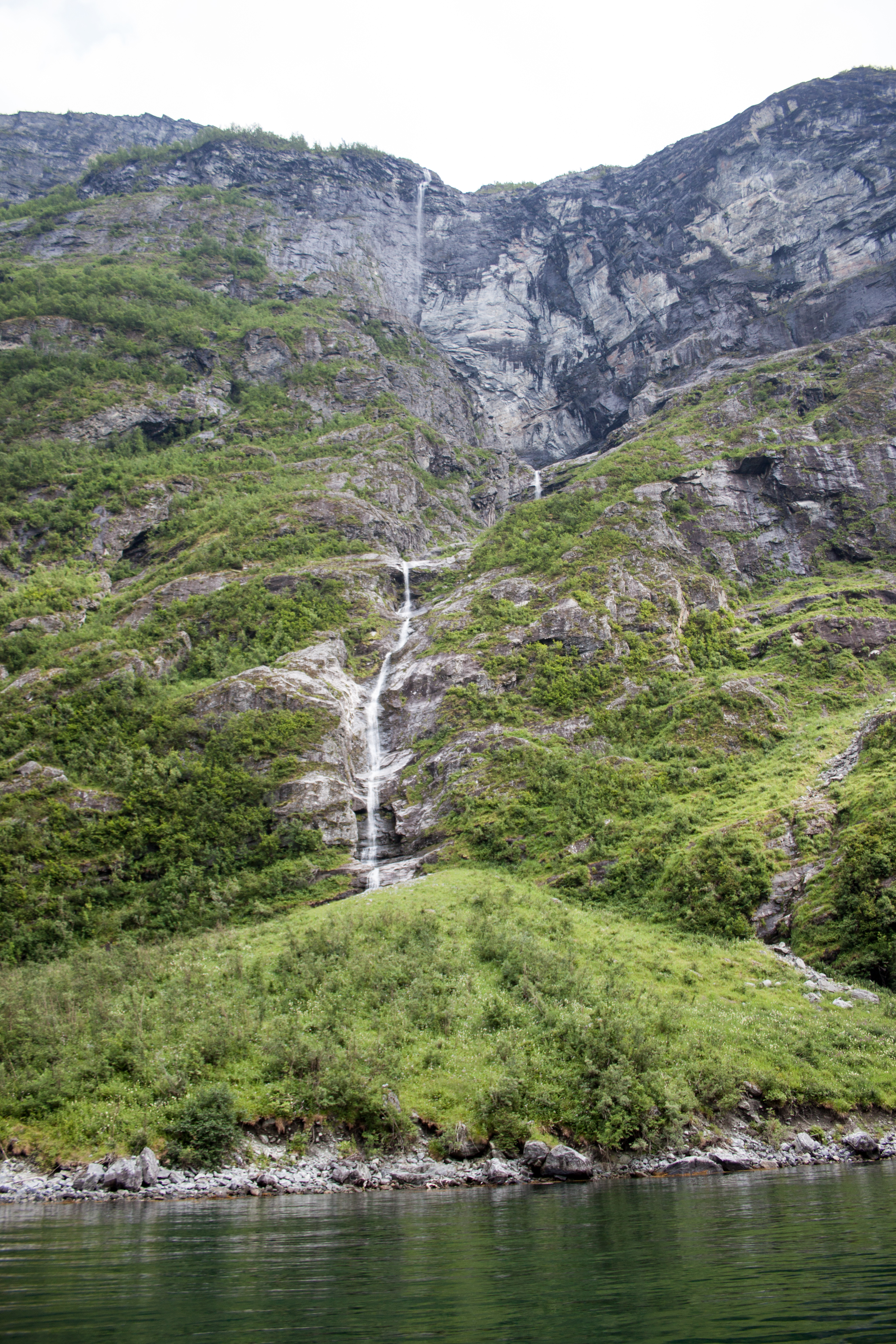
Storfossen is the main attraction: a 35-meter waterfall fed by the Geirangerelva, crashing over exposed rock directly beside the stairs. In spring, snowmelt makes the river enormous. You can hear rocks being shifted by the water pressure. In July, the spray reaches the handrails. In January, the falls freeze into vertical ice columns that local photographers wait all year to shoot.
Grinddalsfossen is visible from the upper sections of the walk. It cascades 660 meters from source to fjord in a series of long, stretched falls down the cliff face behind the village. You see it in the background as you climb, white lines drawn on grey rock. Two rivers merge just before Storfossen: the Grinddalselvi and the Geirangerelva. The confluence is visible from one of the stair landings.
The Norsk Fjordsenter at the top
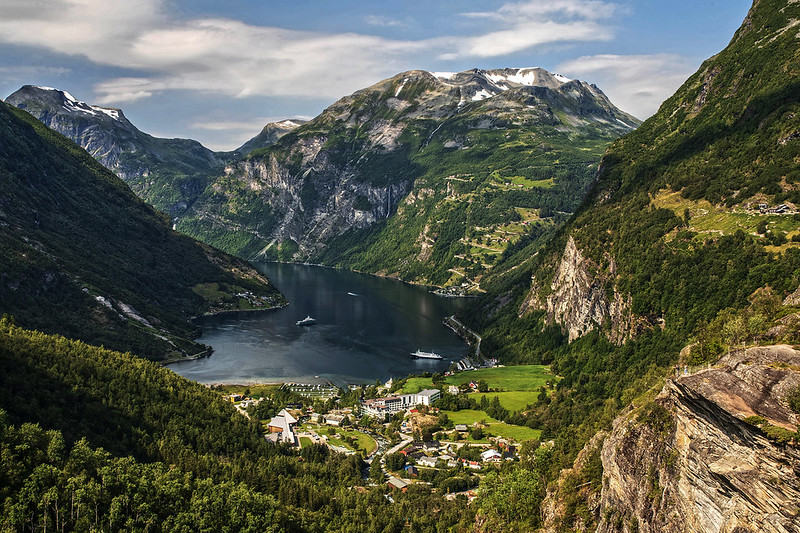
The Fossevandring ends at the Norsk Fjordsenter (Norwegian Fjord Centre), the visitor and education hub for the Geirangerfjord UNESCO World Heritage site. The centre is worth the entry fee for context before you continue hiking the upper Fosserasa trail to Storseterfossen.
The permanent exhibition covers the geological formation of the fjord, local farming history, and the working tools of the families who farmed the cliff ledges above. An outdoor exhibition of bronze sculptures by Ola Stavseng was unveiled by Queen Sonja in September 2025. The Fjordheim children’s exhibition is interactive: glaciers, rivers, and rocks explained for younger visitors. There is a panoramic cinema with a curved screen and seating for 100.
Entry: 160 NOK adults, 85 NOK children (5–15), free under 5, 320 NOK family ticket. Open daily 10:00–16:00 in summer. The centre has a café with local produce, a shop, outdoor picnic area with campfire facilities, a playground, and 24-hour outdoor toilets in summer.
What works
- The year-round access. This is one of the few trails in Geiranger you can walk in any month. In winter, the frozen waterfalls and the blue-hour light create an atmosphere that the summer crowds never see. The trail is lit, so evening walks are possible even during the dark months.
- The engineering. The Corten steel stairs are solid, well-drained, and built with landings every 20 to 30 steps. The handrails are continuous. For an infrastructure project carrying 180,000 visitors annually, the condition is remarkable. Fencing runs along the steeper sections near the river.
- The hydropower history. Two old power plants sit along the route. Most visitors walk past them without noticing. If you look, you see the channels, the intake structures, and the remains of mill dams. These waterfalls generated electricity before they generated tourism revenue. That history adds a layer that the cruise ship passengers rushing through will miss.
- The cruise ship calculation. The trailhead is a 5-minute walk from the cruise pier. The walk takes 30 to 40 minutes up. Add 20 minutes at the top and 20 minutes down, and you are back at the ship in under 90 minutes. No bus, no booking, no guide required.
What does not work
- The midday crowds. When five cruise ships dock simultaneously (the daily maximum is 8,000 cruise visitors), the steel stairs become a queue. Arrive before 09:30 or after 16:00. Evening walks are a genuine alternative: the trail is lit, and the waterfall sounds different in the quiet.
- Accessibility limitations. The 327 stairs make this impossible for wheelchairs and difficult for strollers. If you cannot manage stairs, drive to the Norsk Fjordsenter via the road from Hotel Union and enjoy the exhibitions without the climb. The exhibitions alone justify the visit.
- The wet stairs. Waterfall spray makes the steel slippery, particularly in spring when flow is highest and in winter when ice forms. The slip-resistant surface helps, but shoes with grip are still necessary. Sandals are a poor choice here.
The honest assessment
The Fossevandring is the trail that works for everyone with functioning knees and 90 minutes to spare. It is not a wilderness experience. It is a walk through the infrastructure that built Geiranger: the water, the power, the rock. The 327 stairs are the centrepiece, but the hydropower plants and the Fjord Centre bookend them with context that transforms a simple waterfall walk into an education in how fjord communities survived.
If you are continuing to Storseterfossen, the Fossevandring is the first third of that journey and worth doing even if you plan to drive to Vesteras farm and skip the middle section. If you have only two hours in Geiranger and must choose one thing, this is the thing.
The logistics
| Detail | Information |
|---|---|
| Trail name | Fossevandring (part of Fosserasa Nasjonal Turiststi) |
| Distance | 1.2 km one way |
| Elevation gain | 85 m |
| Time | 30–40 minutes up, 20 minutes down |
| Grade | Green (easy). Stairs with handrails throughout. |
| Season | Year-round (trail is lit at night) |
| Trail fee | Free |
| Fjord Centre entry | 160 NOK adult, 85 NOK child (5–15), 320 NOK family |
| Fjord Centre hours | 10:00–16:00 daily (summer) |
| Start point | Geiranger village, 200 m from cruise pier |
| End point | Norsk Fjordsenter, Gjovahaugen 35 |
| Guided walk | Fjord Ranger tour daily 12:00, from 600 NOK (incl. Fjord Centre entry) |
| Annual visitors | 180,000 (Miljødirektoratet, 2024) |
| Emergency | 112 (police/rescue) or 113 (medical) |
Who should walk this
- Cruise ship passengers with under 2 hours. Five minutes from the pier, no booking needed, free to walk, and you are back aboard in 90 minutes. This is the single best use of a short port call in Geiranger.
- Families with young children. The handrails and fencing make this safe for children who can manage stairs. The Fjordheim children’s exhibition at the Fjord Centre rewards the climb. Strollers do not work on the stairs, but child carriers do.
- Anyone arriving in Geiranger for the first time. The Fossevandring and the Fjord Centre together provide the context for everything else you will see: the waterfalls, the cliff farms, the UNESCO designation. Do this first, then drive the Eagle Road or hike to Storseterfossen with understanding rather than just photographs.
Who should skip this
- Anyone who cannot manage stairs. 327 steps with no alternative route. The Fjord Centre is accessible by road from Hotel Union if you want the exhibitions without the climb.
- Hikers who want solitude. This is the most-walked trail in Geiranger. If you want quiet, drive to Vesteras and start the Storseterfossen or Løsta trail instead.
- Visitors looking for a full-day hike. The Fossevandring is 30 to 40 minutes. It is the appetiser, not the main course. Continue on the Fosserasa trail to Storseterfossen if you want a proper half-day hike.
Ingrid Solheim is the Fjord Logistics Editor at NorgeTravel. She spent eleven years putting tourists into rental cars in Bergen and watching them drive off with itineraries that were never going to work. Her guides are written so that does not happen to you. She can be reached at hei@norgetravel.com.
Images: Geiranger waterfall by Szilas (public domain, Wikimedia Commons). Geiranger panorama by NorgeTravel.